15-07
M.W. Pot, K.A. Faraj, A. Adawy, W.J.P. van Enckevort,
H.T.B. van Moerkerk, E. Vlieg,
W.F. Daamen, T.H. van Kuppevelt,
Versatile wedge-based system
for the construction of unidirectional collagen scaffolds by directional freezing:
practical and theoretical considerations,
ACS Appl. Mater. Interfaces 7
(2015) 8495-8505
Abstract:
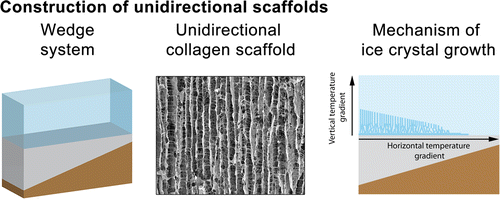
Aligned unidirectional
collagen scaffolds may aid regeneration of those tissues where alignment of cells
and extracellular matrix is essential, as for instance in cartilage, nerve
bundles, and skeletal muscle. Pores can be introduced by ice crystal formation
followed by freeze-drying, the pore architecture reflecting the ice crystal
morphology. In this study we developed a wedge-based system allowing the
production of a wide range of collagen scaffolds with unidirectional pores by
directional freezing. Insoluble type I collagen suspensions were frozen using a
custom-made wedge system, facilitating the formation of a horizontal as well as
a vertical temperature gradient and providing a controlled solidification area
for ice dendrites. The system permitted the growth of aligned unidirectional
ice crystals over a large distance (>2.5 cm), an insulator prolonging the
freezing process and facilitating the construction of crack-free scaffolds.
Unidirectional collagen scaffolds with tunable pore sizes and pore morphologies
were constructed by varying freezing rates and suspension media. The
versatility of the system was indicated by the construction of unidirectional
scaffolds from albumin, poly(vinyl alcohol) (a synthetic polymer), and
collagen-polymer blends producing hybrid scaffolds. Macroscopic observations,
temperature measurements, and scanning electron microscopy indicated that
directed horizontal ice dendrite formation, vertical ice crystal nucleation,
and evolutionary selection were the basis of the aligned unidirectional ice
crystal growth and, hence, the aligned unidirectional pore structure. In conclusion,
a simple, highly adjustable freezing system has been developed allowing the
construction of large (hybrid) bioscaffolds with
tunable unidirectional pore architecture.
Keywords:
regenerative medicine; biomaterials; lyophilization;
anisotropy; collagen
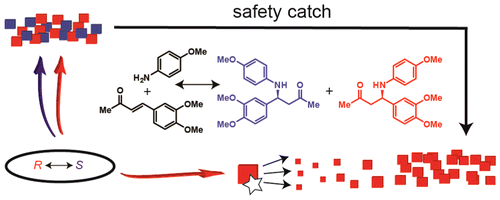
Viedma ripening was recently applied to a reaction enabling
the conversion of achiral reactants in solution into enantiopure
product crystals. Here we show that the configuration of the final product and
the rate of deracemization are highly dependent on
the initial crystal nucleation process or, if applied, seed crystals. Depending
on the nucleation process, the transformation proceeds through total
spontaneous resolution or Viedma ripening. Swift
solid state deracemization can also be achieved using
heating–cooling cycles as an alternative to Viedma
ripening, provided that crystal nucleation results in a sufficiently high
initial enantiomeric excess to trigger the deracemization
process.