16-10
W.J.P. van Enckevort,
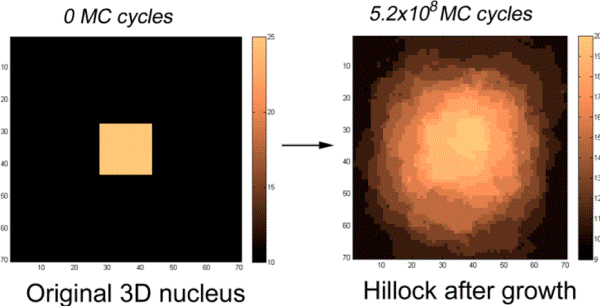
Growth of crystal faces enhanced by 3D nuclei
deposition: a Monte Carlo simulation,
Cryst. Growth Des. 16 (2016) 4402-4410
Abstract:
In general, crystal growth proceeds by the addition of
growth units at steps originating from dislocations or 2D nuclei.
However, evidence exists that small 3D nuclei
deposited on crystal faces can also act as step sources. In this study, the
Monte Carlo method, based on the Kossel model, is used to study the fates of 3D
nuclei adsorbed on planar and stepped crystal surfaces. For equilibrium, Δμ/kT = 0, the nuclei dissolve completely, regardless
of size. For supersaturated solutions, Δμ/kT > 0, the upper parts of the nuclei dissolve, while
the lower parts act as a source of steps expanding over the surface. This
results in flat topped growth islands, the slope of which side faces increases
for increasing nucleus size and supersaturation and decreasing bond strength.
Growth on stepped surfaces leads to the formation of
approximately circular plateaus, the width of which increases with decreasing
substrate slope. Upon continued growth, these plateaus evolve into bunched step
patterns. The Monte Carlo simulations are supplemented with a semiquantitative model, which helps in explaining the
features observed by the Monte Carlomethod.