16-17
M.M.H. Smets, S.J.T.
Brugman, E.R. van Eck, P. Tinnemans, H. Meekes, H.M. Cuppen,
Understanding the single-crystal-to-single crystal
solid-state phase transition of dl-methionine,
Cryst. Eng. Comm. 18 (2016) 9363-9373
Abstract:
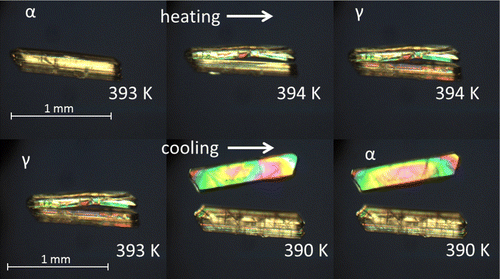
The solid-state phase transitions
between the α, β and γ forms of dl-norleucine were studied using DSC, thermal stage
polarization microscopy and solid-state NMR. Since the crystals consist of 2D
hydrogen-bonded bilayers with van der Waals interactions between consecutive
bilayers, the transitions occur in a layer-wise fashion with a propagating
transformation front. The α↔γ transition at 390 K is a clear
example of a first order transition with a relatively large enthalpy difference
between the polymorphs and a small hysteresis, indicating the kinetic barrier
for this transition is relatively small. In contrast, the α↔β
transition is not reproducible in similar crystals and the enthalpy difference
is very small. Both the α and β polymorphic forms can coexist in a
“single crystal” over a large temperature range, apparently without enforcing
stress, while the α↔γ transition propagates fast to relieve
stress from the volume and conformational change. Moreover, the kinetics of the
α↔β transition are much faster in single crystals than in
powders, which is attributed to the inhibitory effect of defects on cooperative
motion. The thermodynamic transition temperature of the α↔β
transition is estimated between 253 and 268 K. This work also shows that
traditional methods of polymorph screening might overlook some solid-state
phase transitions similar to the α↔β transition
in dl-norleucine.